
Wall Street Journal Affiliate Program: How To Make Money With It
The Wall Street Journal affiliate program offers a straightforward way to earn commissions promoting one of the world’s most trusted financial publications. With payouts up to $30 per digital product sale and global availability through CJ Affiliate, this program suits content creators in finance, business, and news niches. This guide breaks down everything you need to know to start earning.
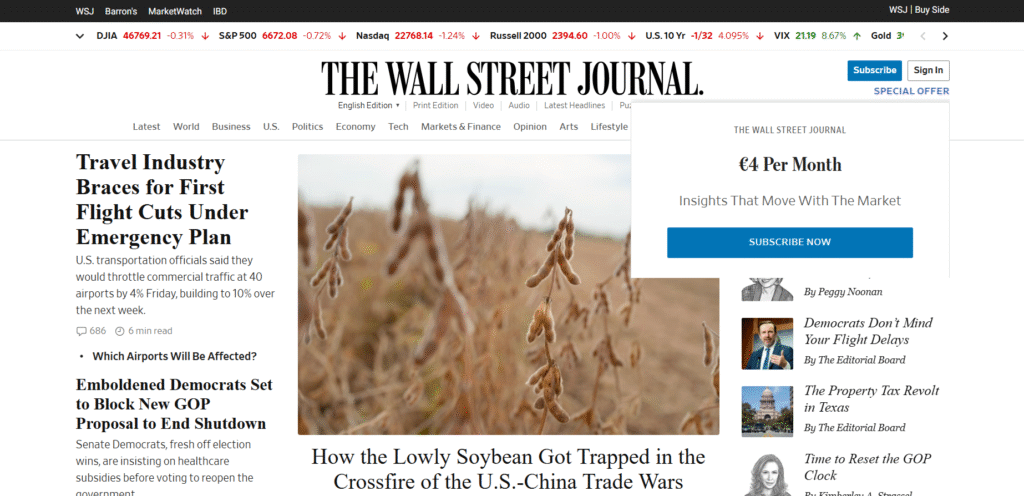
Quick Program Stats
💰 Commission: $6 per new subscriber, up to $30 for digital products
🍪 Cookie Duration: 7 days
💳 Payment Terms: Monthly via check, direct deposit, or bank transfer
🌍 Availability: Worldwide through CJ Affiliate
⏱️ Payment Network: Commission Junction (CJ Affiliate)
What Makes the Wall Street Journal Affiliate Program Worth Your Time
The Wall Street Journal isn’t just another newspaper. It’s the gold standard for financial news and business intelligence. When you promote WSJ, you’re promoting a brand that people already trust and actively search for.
The numbers tell an interesting story. At $6 per new subscriber, you’d need about 167 new subscribers monthly to hit $1,000. But here’s where it gets better. The digital product promotions can pay up to $30 per sale. Land just 34 of those monthly and you’re at $1,020.
Compare this to typical affiliate programs. Most news subscriptions pay between $1-5 per signup. WSJ’s $6 base rate already puts you ahead. The real opportunity is in those higher-ticket digital products.
The brand recognition does heavy lifting for you. You’re not convincing people WSJ is credible. You’re just showing them why now is the time to subscribe. That’s a much easier sell.
Getting Started: Your First 48 Hours
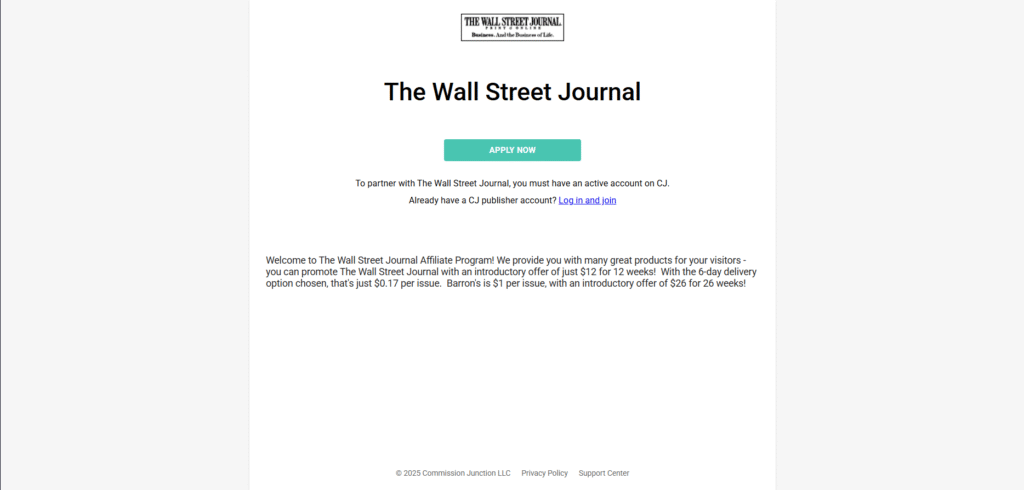
Approval is straightforward. Head to the Wall Street Journal affiliate program page on Commission Junction. You’ll need an active website or content platform. CJ Affiliate reviews applications within 1-2 business days typically.
What they’re looking for: Content relevant to finance, business, investing, or news. Your site doesn’t need massive traffic, but it should show genuine content about topics WSJ covers.
Pro tip: If you’re just starting out, publish 5-10 solid articles about financial news, market analysis, or business strategy before applying. This shows you’re serious and aligned with their audience.
Once approved, you’ll get access to promotional materials and your unique affiliate links. The dashboard shows real-time tracking of clicks, conversions, and commissions earned.
Who Actually Buys Wall Street Journal Subscriptions
Understanding your buyer changes everything. WSJ subscribers aren’t casual news readers. They’re professionals who need financial intelligence for their work or investments.
Your typical converter is: A professional aged 30-55, working in finance, business, or investments. They have disposable income and understand that quality information has value. They’re likely already reading free financial news but need the depth WSJ provides.
Their pain points matter. They’re tired of surface-level financial news. They need analysis that affects their portfolio or business decisions. They want to sound informed in meetings and client calls. They’re looking for an edge their competitors don’t have.
The buying trigger is usually specific. A major market event. A new job that requires staying informed. Tax season when they need investment strategy content. Q4 when they’re planning next year’s business moves.
Target content that addresses these moments. Write about “Best Financial News Sources for Day Traders” or “How Executives Stay Informed Without Wasting Time.” This captures people actively looking for solutions.
Traffic Strategies That Actually Convert
Organic search is your friend here. People literally Google “Wall Street Journal subscription” and “WSJ student discount” millions of times. Create content around these searches.
Content ideas that rank and convert: comparison posts like “Wall Street Journal vs Financial Times,” listicles like “Top 10 Financial Newsletters,” and how-to guides like “Reading the WSJ Efficiently.”
SEO specifics matter. Target keywords like “best financial newspaper,” “business news subscription,” and “WSJ review.” These have commercial intent. Someone searching these is close to buying.
Paid traffic works but requires precision. Facebook and LinkedIn ads targeting finance professionals, business owners, and investors can work. Your cost per click will be higher but so is the conversion rate. A $50 ad spend bringing 2 sales at $30 each nets you $10 profit.
Google Ads on branded terms like “WSJ discount” or “Wall Street Journal deal” can capture high-intent traffic. Just watch your cost per acquisition closely.
Email marketing is underutilized here. Build a list around financial tips or market updates. Provide genuine value for weeks. Then introduce WSJ as the next-level resource. This works because you’ve established trust first.
Social proof accelerates everything. If you’re on Twitter or LinkedIn, share insights from WSJ articles. Show how you use it. People buy what influencers in their niche actually use.
Creating Content That Converts
Your landing page or review post needs specific elements. Skip the fluff about “trusted since 1889.” Everyone knows WSJ is credible.
Lead with the benefit. “Get the market analysis that hedge fund managers read” hits harder than “Subscribe to quality journalism.”
Address objections directly. Yes it costs money. Frame it as cheap compared to missing one good investment opportunity. Yes there’s a lot of free news. Explain why depth matters more than volume.
Use the right call to action. “Start your WSJ trial” converts better than “Learn more.” People want to test before committing.
Showcase specific use cases. Don’t just say “great for investors.” Say “Find undervalued stocks before they trend” or “Spot recession signals early.”
Screenshots help tremendously. Show the WSJ dashboard, a compelling headline, or the mobile app interface. People need to visualize using it.
Real Implementation Example
Let’s walk through a working strategy. You run a blog about personal finance and investing.
Month 1: Publish a comprehensive guide titled “Best Financial News Sources for Investors in 2025.” Include WSJ as your top pick with your affiliate link. Optimize for “best financial news” and similar terms.
Month 2: Create comparison content. “Wall Street Journal vs Bloomberg vs Financial Times.” Give honest pros and cons. WSJ wins on accessibility and breadth. Link to your affiliate offer in the conclusion.
Month 3: Write tactical content. “10 Ways to Use the Wall Street Journal to Find Investment Ideas.” Each tip links to relevant WSJ sections using your affiliate link.
Supporting this: Build a small email list offering a free PDF guide to reading financial news efficiently. Every week, send one insight from a recent WSJ article. Monthly, send a dedicated email about why WSJ is worth the investment.
Expected results: With decent SEO execution, these posts could generate 500-1000 visitors monthly each by month 6. At a 2% conversion rate, that’s 10-20 sales monthly. At $6 base commission, that’s $60-120. Land a few higher-ticket digital product sales and you’re closer to $150-200 monthly from one program.
Scale this: Repeat this content strategy across 5 affiliate programs and you’re building real income.
The Honest Challenges You’ll Face
The cookie duration hurts. Seven days means if someone clicks your link but subscribes 8 days later, you earn nothing. This is shorter than many competing programs offering 30-90 days.
The base commission is modest. At $6 per subscriber, you need volume. You’re not getting rich from 10 sales monthly.
Competition is real. Everyone promotes WSJ. Your content needs to be genuinely better or target more specific niches to stand out.
No dedicated affiliate support. Unlike programs with affiliate managers who help you optimize, you’re largely on your own here. CJ Affiliate provides tracking but not strategic guidance.
Digital product promotions are vague. The “up to $30” claim lacks specifics. Which products? How do you promote them? This ambiguity makes planning harder.
Solutions: Focus on long-tail keywords where competition is lighter. “Best financial newspaper for options traders” is easier to rank than “WSJ review.” Create genuinely useful content that deserves to rank. Build an email list to maintain contact beyond the 7-day cookie window.
Who This Program Isn’t For
Skip this if you’re in completely unrelated niches. Promoting WSJ on a gardening blog won’t work. The audience mismatch kills conversions.
If you need quick cash, look elsewhere. Building organic traffic takes months. Paid traffic requires testing budget. This isn’t a fast-money play.
Avoid if you can’t create quality content. Thin affiliate reviews don’t rank anymore. You need comprehensive, helpful content. That takes time and skill.
Not ideal for beginners with no traffic. The 7-day cookie means you need consistent traffic. Without it, people forget about your link before buying.
Alternative Programs to Consider
Seeking Alpha: Financial analysis platform with recurring commissions. Often pays better long-term.
Motley Fool Stock Advisor: Higher commissions per sale but more expensive for customers, which can hurt conversion.
Bloomberg: Similar audience but different strengths. Tech-focused investors often prefer Bloomberg.
Investopedia: Offers various financial product affiliate programs including brokerages with much higher payouts.
Consider promoting multiple. Don’t put all your effort into one program. WSJ can be part of a broader strategy monetizing financial content.
Making Your First Commission
Here’s your action plan for the next 30 days.
Week 1: Apply to the program through CJ Affiliate. While waiting for approval, research your top 10 target keywords. Create an outline for your first comparison or review post.
Week 2: Write and publish your cornerstone content piece. This should be 2000+ words, genuinely helpful, and optimized for your main keyword. Include your affiliate link naturally in context.
Week 3: Create two supporting articles that link to your main post. These can be shorter but should target related long-tail keywords. Build internal links to strengthen your main post.
Week 4: Promote your content. Share on relevant social media. Email your list if you have one. Consider a small paid promotion budget to jumpstart traffic.
Ongoing: Publish weekly content related to finance and business. Each post is another opportunity to naturally include your WSJ affiliate link. Track what converts and do more of that.
Reality check: Your first commission might take 60-90 days. That’s normal for affiliate marketing. The content you create now builds momentum for months ahead.
Advanced Tactics for Experienced Marketers
Retargeting campaigns work well. Someone who clicked your WSJ affiliate link but didn’t convert is high-intent. Retarget them with Facebook or Google Display ads reminding them about the offer.
Seasonal pushes matter. New Year (resolution traffic), tax season (people want to understand finances better), and Q4 (planning for next year) see higher conversion rates.
Microsites can dominate. Build a dedicated site reviewing financial news sources. It’s easier to rank “FinancialNewsReview.com” for relevant terms than a general blog post.
YouTube has opportunity. “WSJ App Tutorial” and “Is WSJ Worth It?” videos can rank well. Include affiliate links in descriptions.
Podcast sponsorships scale. If you have a finance podcast, sponsored segments promoting WSJ feel native and convert well.
API integration if possible. Some advanced affiliates pull in WSJ headlines via API, creating dynamic content that’s always fresh. This improves SEO and engagement.
Tracking What Matters
Focus on the right metrics. Clicks to your affiliate link matter less than conversion rate. 100 clicks at 5% conversion beats 500 clicks at 1% conversion.
Calculate your effective commission. Track both base subscriber commissions and higher-ticket digital product sales separately. This shows where to focus effort.
Monitor cookie dropout. If you see lots of clicks but few conversions, people may be delaying purchase beyond the 7-day window. This signals you need email follow-up.
Track by content type. Which posts convert best? Comparison posts? Reviews? How-to guides? Double down on winners.
Test different CTAs. “Start your free trial” versus “Get WSJ access” might convert differently. Test and measure.
Final Thoughts
The Wall Street Journal affiliate program won’t make you rich overnight. But it’s a solid building block in a broader affiliate strategy focused on financial content.
The real opportunity is building authority in the finance niche. WSJ is just one of many affiliate programs you can promote to this audience. Brokerages, financial tools, courses, and newsletters all monetize the same traffic.
Start with quality. Create genuinely helpful content about financial news and business intelligence. The affiliate commissions follow naturally when you’ve earned trust.
Join the Wall Street Journal affiliate program and start building your financial content empire today. Your first commission is just one quality article away.